|
|
The Tradition of the Himalayan Masters:
Three Streams of Yoga, Vedanta, and Tantra
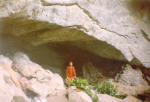 Source of the tradition: The systematic practice of Yoga Meditation
comes from the ancient cave monasteries of the
Himalayas, the source of the mystical Shangrila or Shambala. This
lineage of teachers is at least 5,000 years old, though eternal in nature. It includes Swami
Rama and his teachers Bengali Baba, who is disciple of Mahavatar
Baba, known as Babaji. (See Swami Rama's book, Living with the Himalayan
Masters. Life Positive, an Indian holistic living magazine, has
published a fascinating article on
Mahavatar
Baba.)
(See also Our Tradition by Swami Rama) Source of the tradition: The systematic practice of Yoga Meditation
comes from the ancient cave monasteries of the
Himalayas, the source of the mystical Shangrila or Shambala. This
lineage of teachers is at least 5,000 years old, though eternal in nature. It includes Swami
Rama and his teachers Bengali Baba, who is disciple of Mahavatar
Baba, known as Babaji. (See Swami Rama's book, Living with the Himalayan
Masters. Life Positive, an Indian holistic living magazine, has
published a fascinating article on
Mahavatar
Baba.)
(See also Our Tradition by Swami Rama)
The tradition has no name, and is not affiliated with any of the
institutions or religions of the plains of India or other countries
surrounding the Himalayas, although individual meditators may personally
align themselves with a wide variety of religions or institutions. We may refer to the tradition as "the tradition of the Himalayan masters"
or "the Himalayan tradition", but that is for the sake of convenience,
and is not a style or brand name as is popular these days.
In our tradition deities are thought of only
as symbols, not as realities to be worshipped.
Encompassing all forms of yoga:
The tradition of the Himalayan masters encompasses all of the Yogas. Self-Realization
comes through Yoga meditation of the Yoga Sutras, the contemplative
insight of Advaita Vedanta, and the intense devotion of Samaya Sri Vidya
Tantra, the three of which complement one another like fingers on a
hand (See: Yoga, Vedanta, Tantra). We employ the classical
approaches of Raja, Jnana, Karma, and Bhakti Yoga, as well as Hatha,
Kriya, Kundalini, Laya, Mantra, Nada, Siddha, and Tantra Yoga.
Together, they guide one directly through the layers (Koshas)
of our being to the direct experience of the center of consciousness. Meditation, contemplation, mantra and prayer finally converge into a
unified force directed towards the final stage, piercing the pearl of
wisdom called bindu, leading to the Absolute (See
Bindu).
These
methods self-exploration,
self-discovery, and self-realization include the following:
-
Yoga Sutras: The ancient, oral yoga system,
codified by
Patanjali in the Yoga Sutras is accepted as a preliminary
or foundation step, with yoga resting on the foundation of sankhya
philosophy. Yoga meditation systematically discerns pure consciousness
from the many false identities, attractions, aversions, and fears.
-
Advaita Vedanta: Philosophically, the
Advaita Vedanta system of one absolute Reality
without a second is practiced as elucidated in the
Upanishads, particularly the
Mandukya Upanishad,
relating to AUM and the four
states of waking, dreaming, sleep, and the fourth
state, turiya. Contemplative meditation is a process of inspection within,
exploring the levels of manifestation so as to uncover the absolute
core of one's being.
-
Sri Vidya: Both Mother and Father principles of the universe are acknowledged,
practicing the purely internal form of Tantra
to awaken kundalini and
experience the highest. Maya (illusion) is seen as the creativity of the Mother principle,
and is thus not an obstacle. The inner tantra practices trace all of the inner energies back to their finest
source of pure energy.
-
Specific Practices: Include Meditation
from the Yoga Sutras of Patanjali, Contemplation from
Vedanta, as well Yoga Nidra and Kundalini
practices from Tantra.
See also the articles:
Bindu: Pinnacle of Yoga, Vedanta and Tantra
Yoga, Vedanta and Tantra
Message of the sages: When Swami
Rama's teacher sent him to the West to teach, he instructed him, "To
get freedom from all fears is the first message of the Himalayan sages.
The second message is to be aware of the reality within. Be spontaneous
and let yourself become the instrument to teach pure spirituality without
any religion and culture." (The key to freedom from fears is in
training the mind, such that it does not wander into the distractions that
lead to fear.)
Religions and the absolute: While this ancient tradition of yoga
meditation has influenced many of the world's religions, the tradition itself is not a
religion. All religions are
acknowledged as an expression of the one absolute reality, called by many
names, including God (The fact that all religions arise from the same
source does not mean that they are the same). The individual practitioners of yoga meditation in the
Himalayan tradition have personal roots in virtually all of the world's
most known religions. It is important to note that there is a distinction
between the broader cultural or religious traditions called sampradaya
and the specific initiatory lineages or parampara. Our lineage or
parampara is neither limited to the region of India nor the religion
commonly known as
Hinduism, and has initiates from many countries around the world and
from a diversity of religious affiliations. (See also the article Philosophy,
Not Religion)
Sri Vidya:
Swami Rama explains that "the 'first
thing that you should do is make full effort to convince yourself, to
accept this: 'I am a shrine of the Lord.' First thing. It’s not enough
to believe in God. You say, 'I believe in God because I believe in
myself. I believe I am a Catholic, I am a Hindu, I am a Buddhist, I am
this.' It’s not enough to lead happy life. It’s not enough to make you
happy. You all have religions; you all have churches. So what? Still you
are suffering. Sometimes I find you suffering more than those who do not
have. Because you are not going ahead.
"What actually do you
need? You need to go in systematically.... How your body is composed?
How is it formed? From here you start going inside. If you have known
yourself, you have known the universe. But if you are trying to know the
universe, you are lost in bewilderment. You are lost. So you better
learn to understand yourself first.
"That vidya which leads
you systematically is called Sri Vidya—highest of all vidyas, as mother.
And you are fully protected.... You are very close to mother. I’m
talking about Divine Mother—the mother in you, the shakti in you, the
power in you. Scientists proved that matter is nothing but energy.
Matter can be converted into energy, and energy into matter. It’s all
energy. But that’s all; nothing beyond that.
"Yoga science has gone
to deeper levels explaining that you have shakti within you. And without
that shakti, it is not possible for you to survive, it’s not possible
for you to act and to function. Any part of yourself—even your brain,
your mind, your intellectualization, your convictions, your actions—are
not possible without shakti.
"This systematic path,
loving path, most glorious, majestic path, is introduced by the teacher
when you have enough time. Suppose you say, 'I don’t have time. Swamiji,
can you tell me something about Sri Vidya which you do in two minutes
time, before I go to my office?' He will laugh at you and say, 'I love
you. Okay. Later on when you have time.' So this vidya—there’s a book
called Saundarya Lahari—a wave of beauty, a wave of bliss, a wave of
wisdom.
"So this mother worship
is not the worship of a female deity; it is not.... It’s a systematic
leading to the Source of highest consciousness within you, where you
find unification with the Brahman, the Absolute One....
"There is one thing
very wonderful, and that is you don’t have to be in the temple. You can.
A student of Sri Vidya can go to synagogue, temple, church, Shiva
temple, Krishna temple, any temple—it doesn’t matter. For him or her,
everything is one and the same. It’s not the worship of the woman,
mother, it’s not worship of man, father; it’s the worship of Brahman;
not even worship of neuter gender. The absolute Truth which is
changeless, which is not subject to change, death and decay, that which
is limitless, that Infinite for whom we do not have words, which is
inexplicable."
Swamis: While the lineage is an ascetic tradition of the
Himalayas, and is thousands of years old, some of the sages (though not
all) are also initiates of the
monastic order of Shankaracharya of the 9th century (much later than the
ascetic tradition itself). Swami Rama
directly initiated at least seven people as swamis, and five or
so other students of Swami Rama have since taken swami initiation through those swamis. (To
practice the teachings, one does not have to be a swami.)
Core practices: While the breadth
of the teachings is vast, the core practices have been captured in two
files that can be downloaded in pdf format. Click
here to go to the downloads page, where you will find a booklet that
summarizes the teachings of Swami Rama, entitled "Understanding and
Practicing the Teachings of Swami Rama" (39 pages), and a paper by
Swami Jnaneshvara entitled "The Path" (49 pages), which also
summarizes the systematic practices as taught by Swami Rama. The many
articles on the SwamiJ.com website also attempt to capture the spirit of
these teachings and practices in simple, straightforward language.
Diversity of links: This tradition of the Himalayan sages is
not itself representative of any formal institutions, although individual
teachers or students have started various teaching organizations or
service institutions from time to time. Thus, a variety of modern teaching
centers may link themselves to this ancient lineage of yoga meditation, while none of them
are themselves sole representatives (though some may claim this). This can be somewhat confusing
to modern seekers who are accustomed to thinking of spiritual lineages as
if they can be fit into neat, corporation-like organizational
charts.
Holograms and chains: The
Himalayan tradition is more like a hologram than a chain. With a chain,
one link is sequentially connected to the next link. With a hologram, the
whole is contained in each of the parts of the holographic image. While
one student may have a specific teacher, and subsequently have his or her
own students, the tradition itself is more like a holographic collective
consciousness that operates throughout the many. That consciousness may at
times be highly concentrated and manifested through, or as one person.
Successor ship:
One of the foremost of the modern representatives of the Himalayan
tradition is Swami Rama. As have others from the tradition, Swami Rama
started several institutions that continue to operate with their
independent leadership. However, Swami Rama did not install any
individual person as his successor in the lineage, although there have
been false claims to that effect.
If it were not so sad, it would be utterly humorous the way in which a few
of Swami Rama's students have behaved, as if their institutions or
ashrams are, themselves, heirs to the tradition of the Himalayan
masters. Ironically, Swami Rama himself has written that the tradition
itself is not related with the institutions of the plains.
Guru: Guru is not
considered to be any person, though the force of guru may operate through
a person. Teachers may be respected, but are not objects of worship.
"Gu" means "darkness" and "ru" means
"light." Guru is the light that dispels the darkness of
ignorance. (See the articles Guru and the
Light Within and Guru and Divine
Grace)
Shaktipat: Along with the sincere efforts of the seeker, obstacles are
removed through a bestowing of grace called shaktipat. It
is through such direct transmission that the highest teachings are given.
Second to that are the oral teachings, while third are written teachings.
External rituals: All of the practices are internal and no rituals are
performed (some locations have started doing rituals either after Swami
Rama disaffiliated from the organization or after he left his body).
Conversion, culture, and God: There is not a belief in conversion, changing the cultural habits of
others, or introducing any face of God in particular.
Serving humanity: Serving humanity through selflessness is an expression of love which one
should follow through mind, action, and speech.
Like trying to hold a cloud: Trying to grasp the tradition of the
Himalayan masters is like trying to grab a cloud. Try as you will, you
cannot quite hold it in your hand, but only in the inner chamber of your
heart. It is from that inner place where one is truly guided by the
masters.
This site is devoted to
presenting the ancient Self-Realization path of
the Tradition of the Himalayan masters
in simple, understandable and beneficial ways, while not compromising
quality or depth. The goal of our sadhana or practices is the highest
Joy that comes from the Realization in direct experience of the
center of consciousness, the Self, the Atman or Purusha, which is
one and the same with the Absolute Reality.
This Self-Realization comes through Yoga meditation of the Yoga
Sutras, the contemplative insight of Advaita Vedanta, and the
intense devotion of Samaya Sri Vidya Tantra, the three of which
complement one another like fingers on a hand.
We employ the classical approaches of Raja, Jnana, Karma, and Bhakti
Yoga, as well as Hatha, Kriya, Kundalini, Laya, Mantra, Nada, Siddha,
and Tantra Yoga. Meditation, contemplation, mantra and prayer
finally converge into a unified force directed towards the final
stage, piercing the pearl of wisdom called bindu, leading to the
Absolute.
|
|